

Developing a FIFA-Grade School Football Facility Under Complex Site Constraints
Project Background
One of the Largest School chain group approached us for developing a FIFA-grade school football facility. Their engineering team had few conditions of developing a football ground.
- The ground should be natural grass and not synthetic turf.
- The ground should be of FIFA standards.
- The fencing should be of 25 feet high and also it should be with chain link fencing and not nylon fencing.
Site Constraints & Technical Challenges to develop a FIFA Grade School Football Facility
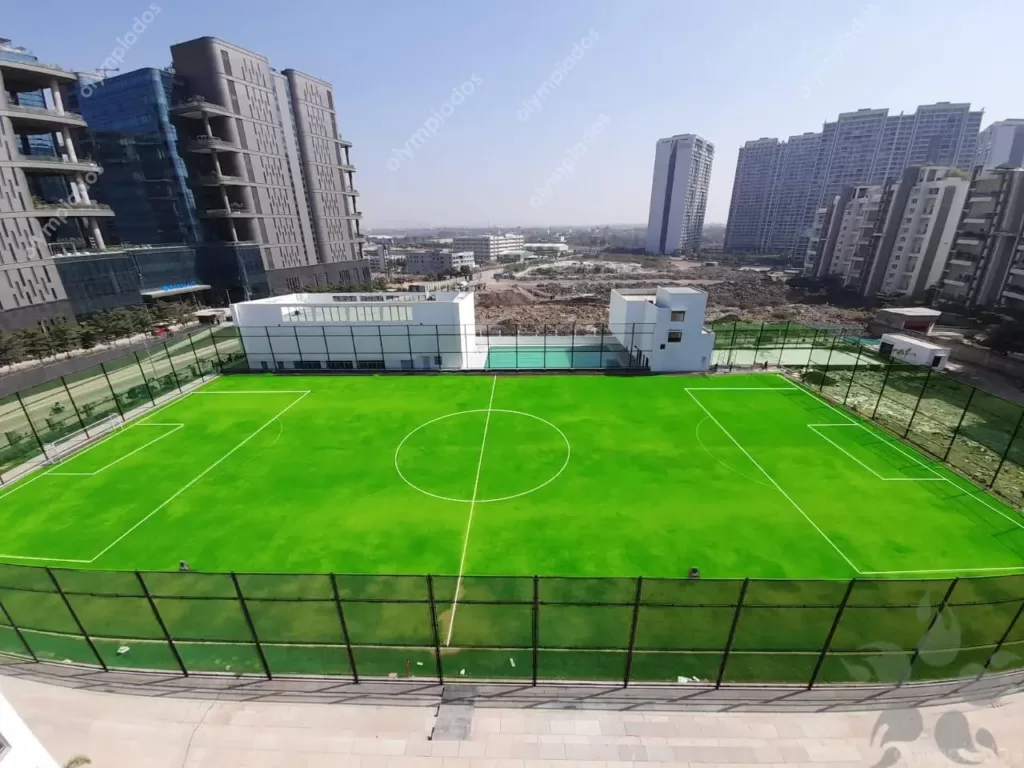
Although the demand seemed reasonable other than the challenge of a chain link fencing of 25 feet height. However, when our team visited the site the the site investigation revealed significantly greater technical complications than initially anticipated. Because, the site had been dumbed with boulders and debris, which made the sub-base practically difficult for a natural grass playing field.
For a natural grass field sub-base becomes the most crucial for aeration, drainage and settlement issues. Removing the boulders and debris seemed impractical because of the nature of the soil present- black cotton soil and also the filling was more than 6 feet.
Project Challenges
- Black cotton soil conditions
- Boulder and debris-filled sub-base
- Settlement risk for natural grass field
- High-performance drainage requirements
- 25-foot chain-link fencing wind-load concerns
- FIFA-grade playing surface expectations
Engineering Strategy & Technical Resolution
Since we had no other option other than to work around the available conditions, a revised engineering approach was developed to address the site’s sub-base instability and drainage limitations. New approach to the problem with an inventive design rather than following a traditional natural grass base design consideration. First we wanted to avoid with voids and settlement so we made a special mix of GSB in multiple layers and did watering compaction. Once we achieved the 96% compaction test passed we separated the layer with a geo fabric, which suited the percolation limited to the new design.
Before the geo fabric, we designed a new concept of an underground drainage system rather than going with the regular herringbone model. The underground drainage network was redesigned with revised perforated pipe diameters and expanded lateral distribution to improve water evacuation efficiency. The whole idea was to create a highly efficient underground drain system to prevent water logging and ensure pitch performance.
We made changes to the base layers suiting to the percolation of water and aeration to grass roots. The other major consideration was of ball bounce and ball rolling. The outer drain made adjustments suiting to the levels and even going as deep as 1.5 m at places. ensuring the playing field is not flooded and quickly drained.
Solution to Chainlink Fencing
For a 25 feet height the preferred route is to go with the nylon net as it is light weight and wind load is not affected. Since the requirement was of Chain link fencing, we made a special design considering the structural integrity is not affected and wind load. We designed special kind of clamps to tighten the chain link fencing and aesthetically looks good. We made the structural design suiting all the conditions and also customized the chainlink so that the sagging can be avoided.
Project Outcome
The project resulted in a FIFA-grade natural grass football facility engineered to address challenging sub-base and drainage conditions while maintaining long-term surface performance and operational reliability.
The facility has subsequently supported elite academy-level football training operations, including a major Real Madrid academy program.
Key Advisory Insight
High-performance natural grass football facilities are heavily dependent on sub-base engineering, drainage integration, and long-term settlement control — particularly in difficult soil conditions such as black cotton soil regions.