

Are Our School Playground Safety Standards Stuck in the Past?
Having spent years planning, executing and consulting school sports infrastructure. It is deeply disturbing with the fact that our system or the safety standards that regulate these curriculums has little concern for a child safety or performance. India’s school playground safety standards need urgent rethinking if we are serious about child safety, physical literacy and sports development.
Do CBSE and ICSE Mandate Synthetic Turf?
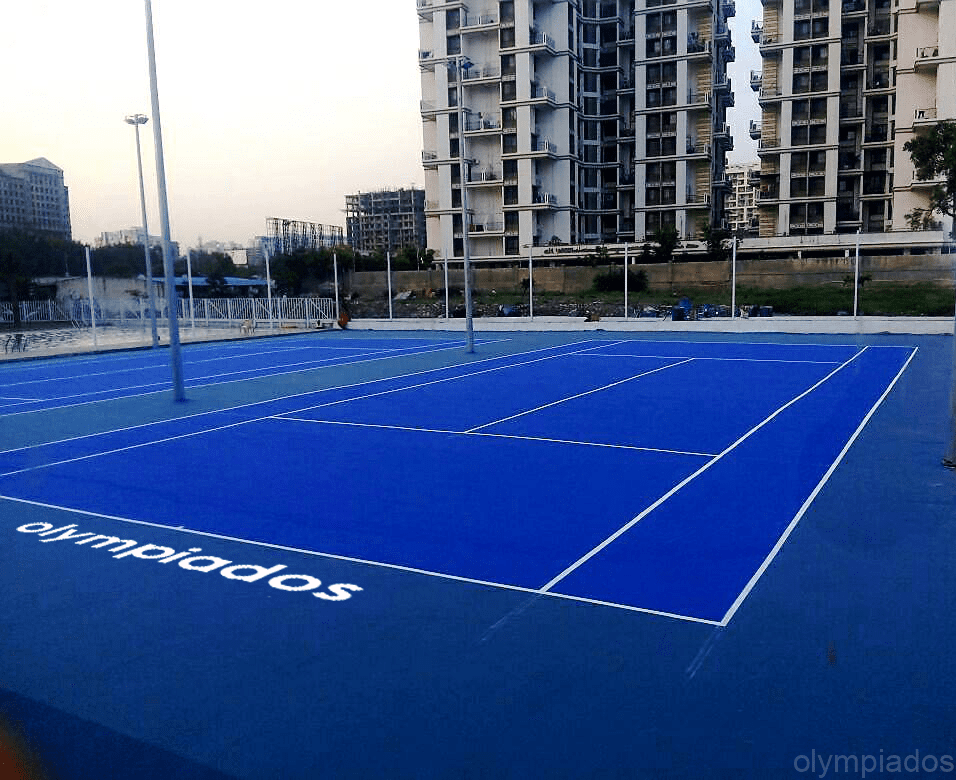
A common misconception among school promoters is that they must spend millions on synthetic turf or acrylic courts to satisfy board inspectors. The reality? Neither CBSE nor ICSE bylaws mention synthetic surfaces for standard affiliation. Instead we’re still clinging to outdated benchmark and standards, where safety is a luxury or an afterthought and athletic performance is entirely ignored.
Decoding BIS and National Safety Council Standards for Indian Schools Playground Safety
It is surprising to learn that as per the standards set by the BIS injury prevention clause for a school is; the play area should be flat, levelled and free of physical hazards.
During a virtual or a physical inspection by the board a school’s accreditation can be flagged or put on hold if they found that the play area is not as per the National Safety Council. And the stipulations of safety parameters are sports surface features exposed tree roots, open drainage pits, concrete footings, jagged stone debris, or asphalt cracks.
Are we measuring school playground safety by the absence of accidents, or by the presence of environments that support healthy child development? India’s school playground safety philosophy appears to focus on preventing obvious physical hazards.
If children’s safety is a national priority, why haven’t playground standards kept pace with international best practices?
Beyond Hazard Prevention: Adopting International Playground Practices
Indian School playground safety standards compared to other major economies
The rest of the world has moved towards designing playgrounds that actively promote safety, healthy risk-taking, accessibility, child development, and inclusion. When several developing nations have modernized their playground safety frameworks, what is preventing India from doing the same?
When will Indian school playgrounds be treated as critical educational infrastructure rather than leftover open space?
Many parents pay premium school fees with the expectation that every aspect of the learning environment, including playgrounds meets modern standards. Is that expectation consistently being met?
If schools are entrusted with our children’s safety and the future, should playground standards extend beyond eliminating obvious hazards? These standards are grossly inadequate for modern school playgrounds.
Why Playground Inspections Matter as Much as Classrooms and Labs
- We inspect laboratories because science matters.
- We inspect libraries because learning matters.
- We inspect classrooms because education matters.
Then why do we continue to inspect playgrounds as though they are merely empty pieces of land instead of one of the most important learning environments a child experiences every day?
Securing India’s Grassroots Talent for Olympic Success
Importance of School Playground Safety Standards
For a fast-developing economy like India that is building physical infrastructure rapidly while shifting away from basic macro-safety toward micro-engineered, legally enforceable safety frameworks. For a country who is imagining and celebrating Olympic medals and developing grassroot level talent, which is the better place than a school?
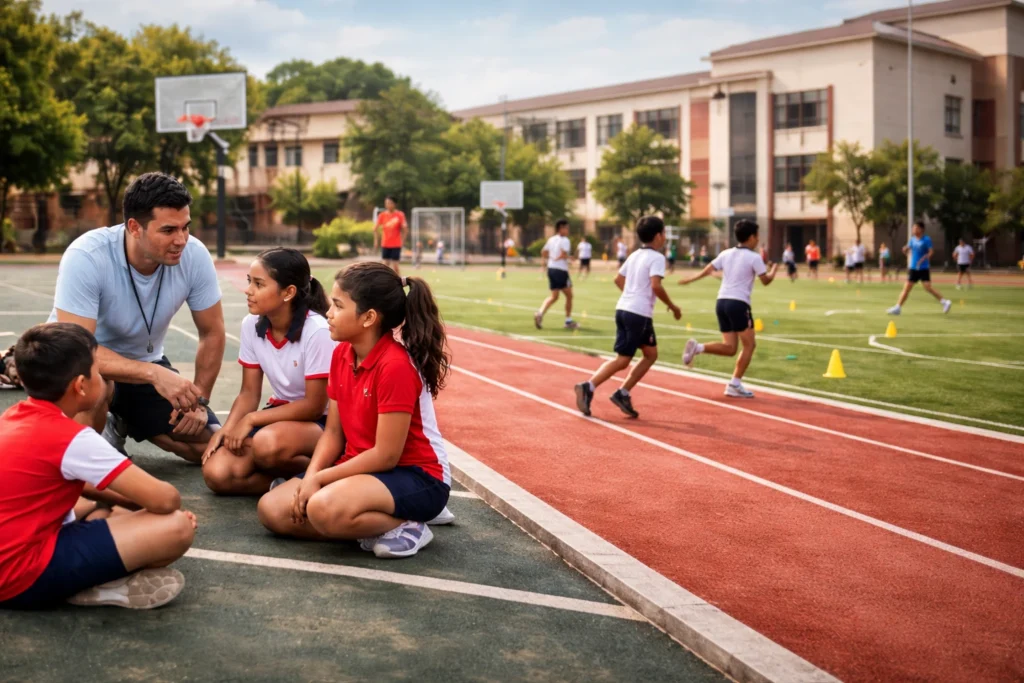
Every Olympic athlete begins somewhere. Very few begin in elite academies. Most begin by running, jumping, falling, competing and discovering their abilities in school playgrounds. If those environments fail to inspire movement, confidence and skill development, we narrow our future talent pool long before children ever reach organised sport.
Modern playgrounds are not designed solely to produce champions. They build coordination, confidence, resilience, teamwork, physical literacy and lifelong participation in sport. Elite performance is only one outcome of a well-designed play environment.
India has every reason to dream of Olympic success. But Olympic ambition cannot begin at sixteen years of age. It must begin when a child first steps onto a school playground. Until our playground standards reflect that reality, we will continue investing in elite performance while neglecting its foundation.