

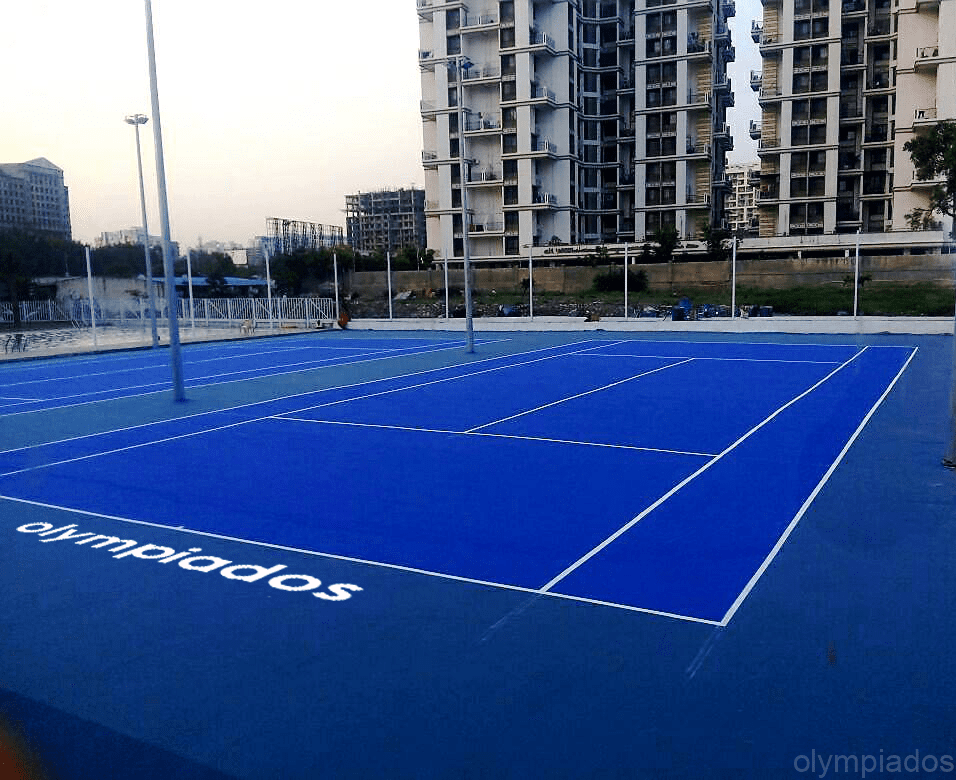
Why do most concrete base for outdoor sports courts fail in India
Most outdoor sports courts in India fail within a few years—not because of the surface, but because of the base.
Concrete (PCC or trimix) is widely used for outdoor courts because it is strong and easily available. However, what works for buildings does not necessarily work for sports infrastructure.
Sports courts require precision, flexibility, and long-term performance under changing weather conditions. A rigid concrete base often struggles to meet these requirements, leading to cracks, uneven surfaces, and premature failure.
Before finalizing your court construction, it is critical to understand whether concrete is truly the right foundation for outdoor sports courts.
Every sport has defined technical standards for slope, flatness, and surface tolerance. For example, tennis courts follow strict ITF guidelines, while basketball courts adhere to FIBA standards.
Achieving these tolerances on a concrete base is extremely challenging in real-world conditions. Even minor undulations beyond acceptable limits can impact ball behavior and player performance.
Additionally, outdoor courts are exposed to temperature variations, moisture, and ground movement. Concrete, being a rigid material, does not adapt well to these conditions, making it prone to surface inconsistencies over time.
This mismatch between technical requirements and material behavior is where most concrete-based courts begin to fail
Disadvantages of concrete base for outdoor courts:
Disadvantages of Concrete Base for Outdoor Courts
* Cracking is inevitable due to thermal expansion, contraction, and ground settlement
* Difficult to achieve required flatness within ITF/FIBA tolerance limits
* Poor drainage handling, leading to water stagnation and surface damage
* Surface undulations over time, affecting play quality
* Rigid structure, causing higher stress on joints and increasing injury risk
* Reflective cracking, where cracks appear through acrylic or synthetic layers
* Chipping and surface damage due to poor workmanship or curing issues
Even when constructed correctly, concrete bases tend to deteriorate faster under outdoor sports usage compared to more flexible alternatives.
The core issue with concrete is not its strength—but its rigidity.
For outdoor sports courts, a more effective solution is a bituminous (asphalt) base combined with proper drainage and layering systems. This approach provides flexibility, better bonding with surface materials, and improved long-term performance.
A well-designed base system can significantly reduce cracking, improve playability, and extend the lifespan of the court.
Choosing the wrong base often leads to recurring repair costs and compromised playing conditions.
If you are planning an outdoor sports facility, base design should be finalized before selecting the surface.
👉 Talk to us before you build. We help you get the foundation right.